
Traveler asks what an all-inclusive Punta Cana trip costs

There is no single number, but there is a reliable formula: a Punta Cana all-inclusive trip costs the round-trip flight, plus the nightly resort rate multiplied by the number of nights, plus whatever the resort's "all-inclusive" label does not actually cover. For one traveler on a mid-tier resort for a week, that combination typically lands somewhere in the low-to-mid four figures once flights and extras are added; for a couple, doubling the room cost while splitting the flight and transfer costs per person usually brings the per-person total down, since the room rate is quoted per room, not per head.
The three components move independently, which is why quoting one figure is misleading. Flights fluctuate with origin city and booking window. Resort rates depend on season, brand tier and room category — an oceanfront swim-up suite at a golf-and-spa resort costs multiples of a garden-view room at a mid-market property. And "extras" is a real budget line, not a rounding error, because the inclusive rate stops short of several categories guests assume are covered.
What moves the total most
The two levers with the biggest swing are the resort tier and the travel season. A traveler comparing properties on Costco Travel's Punta Cana package listings or Vacation Express will see nightly rates at the same resort shift by season even before comparing brands against each other. The third lever, booking channel, matters less for the nightly rate itself and more for whether flight, transfer and resort get bundled into one price or priced separately.
Building your own estimate
- Price the round-trip flight to Punta Cana International Airport (PUJ) for your actual travel dates first, since airfare is the most origin-dependent piece.
- Pick a resort tier (see the next section) and pull its per-night rate for your travel week from the resort's own site or a package seller.
- Multiply nightly rate by nights, then add flight cost.
- Add a per-day allowance for anything the resort excludes from its inclusive rate — spa, excursions, motorized water sports, top-shelf liquor, gratuities.
- Compare that total against a bundled vacation package price for the same dates and party size before booking either piece separately.
That sequence gives a reader a number specific to their own dates and party size rather than a generic average that may not reflect current season pricing.
Traveler wants the 'nicest' or 'most luxurious' resort

"Nicest" and "most luxurious" are not the same question, and answering either one requires criteria, not a single winner. Service ratio, suite category, on-site golf access and the caliber of specialty dining separate a genuinely luxury property from a resort that is simply pleasant and well-located, and each of those signals correlates with a higher nightly rate rather than with the all-inclusive label itself, since "all-inclusive" describes a pricing model, not a quality tier.
Signals that separate luxury from mid-tier
- Suite category and room size: butler-service or swim-out suites versus standard double rooms.
- Dining variety: multiple specialty restaurants with reservations versus a single buffet plus one or two à la carte options.
- Golf access: an on-site championship course, a differentiator among the higher-end Punta Cana properties, versus no golf at all.
- Adults-only versus family: adults-only resorts often run quieter pools and a different activity slate than family resorts with kids' clubs and water parks.
- Brand positioning: resorts marketed around all-day sport and activity credits, like Club Med's Punta Cana property, versus resorts built around a spa-and-suite luxury pitch, like Excellence Punta Cana.
Independent aggregation of guest ratings and resort features, such as U.S. News & World Report's ranked list of Punta Cana all-inclusive resorts, is a useful way to cross-check a shortlist because it scores properties on comparable categories rather than each resort's own marketing copy. Once a traveler decides between adults-only and family-friendly, the shortlist narrows by roughly half before price ever enters the comparison, which is a faster filter than sorting by nightly rate first.
Flights land at Punta Cana International Airport (PUJ)
Every commercial flight into the region lands at Punta Cana International Airport, and from there a resort transfer is a separate, necessary step because Punta Cana's resorts are spread along a long stretch of Bavaro-area coastline rather than clustered next to the airport. Drive times to individual resorts vary with how far up or down the coast the property sits, so the transfer is not a fixed, negligible add-on — it is a line item that depends on which resort you booked.
Whether that transfer is already paid for depends entirely on how the trip was booked. Bundled vacation packages sold through sellers like JetBlue Vacations, Vacation Express or Costco Travel frequently include ground transfer to the resort as part of the package price, while a flight and room booked separately usually leaves the traveler to arrange and pay for a transfer independently, whether that's a private car, a shared shuttle or a rental.
Before you book: confirm the transfer
- Check whether the "vacation package" price on the seller's page explicitly states "transfers included," rather than assuming it based on the word "package."
- If booking flight and resort separately, price a private or shared transfer for your specific resort's distance from PUJ before finalizing the trip total.
- Ask whether the resort itself offers a transfer as part of any add-on booked directly with the property, since some higher-tier resorts include it in premium suite categories.
Skipping this check is the most common way a traveler's on-paper trip total turns out lower than what they actually pay on arrival.
All-inclusive resort
An all-inclusive resort is a pricing and accommodation model where one quoted room rate bundles lodging, meals, drinks and most on-site activities, rather than billing each of those separately the way a standalone hotel does. In Punta Cana, this model is close to universal — nearly every resort marketed to leisure travelers along the Bavaro coast operates on an all-inclusive rate rather than a European-plan or room-only rate.
What "all-inclusive" bundles varies by resort, but the exclusions are consistent enough to plan around. Standard exclusions across most Punta Cana properties include premium or top-shelf liquor brands (house pours are included, name brands often cost extra), spa treatments, motorized water sports like jet skis and parasailing, off-site excursions, and gratuities, which many resorts note are not mandatory but are customary. A traveler comparing two resorts at the same nightly rate should check what each one's inclusive tier actually covers — dining variety and drink brand inclusion differ meaningfully even between resorts marketed at the same price point, as seen comparing a golf-and-sport-focused property like Club Med Punta Cana against a suite-and-spa-focused property like Excellence Punta Cana.
Budgeting a daily allowance for these exclusions — even a modest one for gratuities and one or two excursions — keeps the "all-inclusive" total honest rather than assuming the quoted rate is the entire trip cost.
Vacation package
A vacation package is a bundled purchase that combines flight, resort stay and (often) transfers into a single transaction and a single price, sold by travel sellers rather than by the resort itself. Sellers active in the Punta Cana market include Costco Travel, Vacation Express and JetBlue Vacations, each of which lets a traveler pick departure city, resort and dates and returns one combined price.
Package versus booking separately
| Factor | Bundled package | Booking separately |
|---|---|---|
| Price transparency | One combined total, harder to isolate per-component cost | Flight and resort priced independently, easier to comparison-shop each |
| Transfer inclusion | Often included | Usually arranged and paid for separately |
| Flexibility | Locked departure city/airport tied to the package seller's routes | Free choice of airline and routing |
| Best for | Travelers who want one price and minimal coordination | Travelers chasing a specific flight deal or loyalty program |
The right answer depends on the traveler more than on either channel being categorically cheaper. A traveler already holding airline miles or a preferred carrier often does better pricing the flight alone and booking the resort directly or through a package seller for the room-only portion. A traveler with no strong airline preference and limited time to compare quotes usually finds a bundled package faster to book and, since transfers are frequently included, less likely to produce a surprise cost on arrival.
Pool
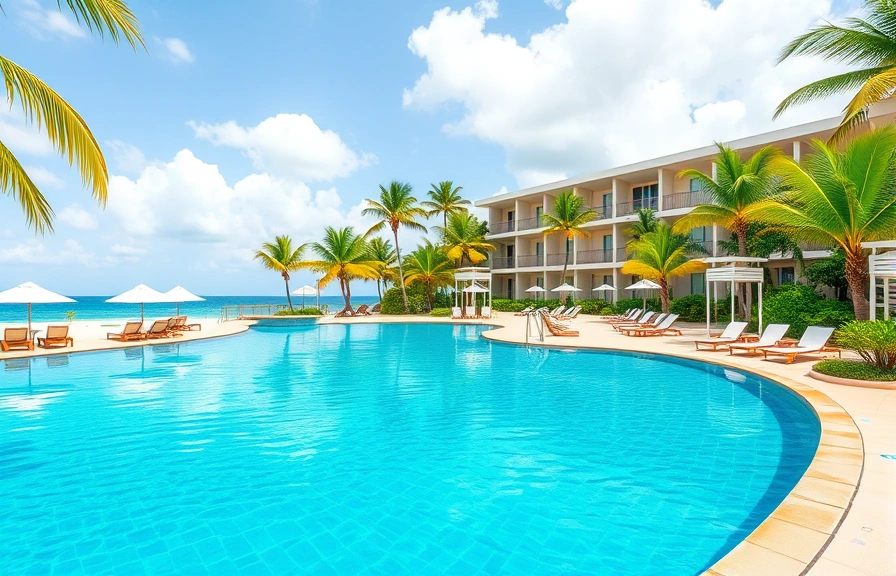
Pools are a standard, expected amenity at Punta Cana all-inclusive resorts, and most properties operate more than one — a main pool, at least one quieter or adults-only pool, and swim-up-accessible pools tied to specific room categories. Rooms with direct swim-up pool access are typically a distinct, higher-priced room category rather than a standard inclusion, so a traveler who wants that feature should check the resort's room-category list rather than assuming any room provides pool access.
Family resorts commonly add a water-park-style pool or slide feature aimed at children, while adults-only properties tend toward a single large main pool plus one or more smaller quiet pools. This is one of the more reliable, checkable differences between an adults-only and a family-oriented resort when comparing amenity lists side by side.
Golf course
Golf access is one of the clearer differentiators among higher-end Punta Cana resorts, since it is expensive real estate and infrastructure to maintain and is far from universal across the region's properties. A resort with an on-site championship course markets it prominently, and access — whether included in the room rate or billed as a separate greens fee — is worth confirming before assuming it's part of the all-inclusive package, since golf is one of the amenities most often carved out as a paid add-on even at otherwise fully inclusive resorts.
Golf access is a reasonable proxy for a resort's luxury positioning generally: properties investing in an on-site course also tend to invest in suite categories, specialty dining and service ratios, all of which push the nightly rate higher. A traveler filtering a shortlist for luxury signals can use "has on-site golf" as one fast checkable filter alongside suite category and dining variety.
Beach
The beach is the primary draw of the destination, and nearly every resort in the region fronts the same style of coastline — the long stretch of white sand generally referred to as Bavaro Beach, which runs along much of Punta Cana's resort corridor. Because the coastline is largely continuous and similar in character resort to resort, beach quality is a smaller differentiator between properties than suite category, dining or golf access; the meaningful differences are more about beach chair density, water-sports concessions and how much of the shoreline a given resort controls than about the sand or water itself.
For a traveler weighing resorts primarily on cost, this is useful: paying a premium for a beachfront resort over a resort set slightly back from the water is buying convenience and a shorter walk, not a fundamentally different beach experience, since the coastline quality itself is broadly consistent across the Bavaro-area resort strip.
Start by pricing your own flight and shortlisting two or three resorts at the tier you can actually afford, then run the five-step estimate above against each one before comparing bundled package prices for the same dates.